

Anyone who gives you a straight dollar figure for running commercial air conditioning is guessing. What they can tell you is which four things are moving the number, and which of them you control.
It is the question we get asked more than any other, and the honest answer frustrates people: it depends. Two businesses on the same street, in similar buildings, running similar equipment, can be hundreds of dollars a quarter apart. The difference is rarely luck.
The useful version of the answer is not a number at all. It is knowing which four factors drive commercial air conditioning running costs, roughly how much each one matters, and which ones you can do something about without replacing a thing.
Quick summary
- There is no standard figure for air conditioning running costs, because the same equipment behaves very differently building to building.
- Four factors do most of the work: the temperature you set, the equipment itself, the quality of the installation, and whether the system is correctly sized.
- The set point is the fastest lever. Australian Government guidance puts the saving at up to 10 per cent for each degree you ease off the thermostat.
- Commercial power bills often include a demand charge based on your single highest usage spike, which is why how you start the system matters as well as how long you run it.
- Eastland services and repairs commercial air conditioning across Coffs Harbour and the Mid North Coast, and can assess why a specific system is costing what it is.
How much does commercial air conditioning cost to run?
Any accurate answer is a range so wide it is useless on its own. That is not evasion, it is arithmetic: consumption is the product of how much heat the building gains, how efficiently the equipment moves it, and how many hours it runs, and all three vary enormously between sites.
A sandwich shop with a street-facing door propped open all day and a west-facing window is a fundamentally different problem to an insulated office suite of the same floor area. Comparing their bills tells you nothing. Comparing your own bill against what it should be, given your building, tells you a great deal.
Factor 1: The temperature you set
The thermostat is the cheapest and fastest lever available, and it is consistently the most underused.
Every degree is real money
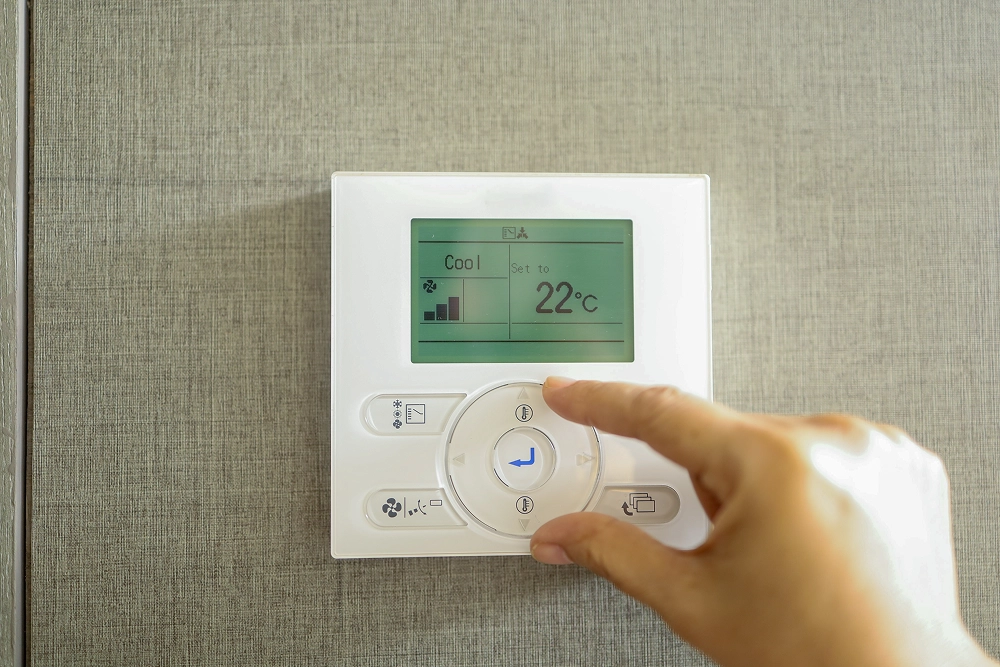
Australian Government guidance is specific on this: you can save up to 10 per cent on cooling for each degree you raise the set point, and the same applies in reverse for each degree you lower it in heating. That is not a rounding error. Moving a site from 21 degrees to 24 in summer is a meaningful change to the quarterly bill, and most occupants will not notice it as discomfort.
The practical trap is the one degree that never gets set back. Someone is cold in July, drops the cooling set point in January by habit, and nobody revisits it for two years.
Set points that work in a commercial space
For most commercial premises, a summer set point in the mid-twenties and a winter set point around 20 keeps people comfortable without asking the system to fight the climate. Somebody should own that decision, and controls should not be freely adjustable by every occupant, or the set point drifts toward whoever feels the cold most.
On a humid Mid North Coast day, comfort is as much about moisture as temperature. A system running a sensible set point for a longer, steadier cycle will often feel better than one chasing a low number in short bursts.
Factor 2: The equipment itself
What is installed sets the ceiling on how efficient the site can be, whatever you do with the controls.
Inverter technology versus fixed speed
An inverter system varies compressor speed to match the load instead of running full tilt then shutting off. That means less energy wasted on repeated starts and steadier conditions in the space. It is the single biggest equipment-level difference in air conditioning power consumption between an older commercial unit and a current one.
What efficiency ratings do and do not tell you
Ratings are measured under standard test conditions, which are not your building on a humid February afternoon. They are genuinely useful for comparing two units against each other, and much less useful as a prediction of what a unit will cost you in situ. Treat the rating as a comparison tool rather than a forecast.
Age and condition
A system loses performance as it ages, and a neglected one loses it faster. Dirty coils, tired fans and a slightly low refrigerant charge all push consumption up without ever presenting as a fault. This is where regular servicing pays for itself, and of the four factors it is the cheapest one to act on.
Factor 3: The quality of the installation
This is the factor almost nobody considers when comparing quotes, and the one we most often find at the root of a bill that makes no sense.
Pipework, connections and leaks
Refrigeration pipework that has not been brazed properly, joints that were rushed, and a system that has been slowly losing charge since the day it was commissioned all force the equipment to work harder for less result. A system running on a low charge can still cool. It just costs considerably more to do it, and it wears itself out in the process.
Ductwork, airflow and insulation
On a ducted system, air escaping through poorly sealed joins is conditioned air you paid for and never received. Ductwork run through a hot roof space without adequate insulation loses performance the same way. None of it is visible from inside the building, which is exactly why it persists for years.
Factor 4: Whether the system is the right size
A system that is too small runs flat out and never rests. One that is too large short cycles, wearing itself down and controlling humidity poorly. Both cost more to run than a correctly sized system doing the same job comfortably.
Sizing is set at the quoting stage and it is expensive to fix afterwards, so it is worth getting right before you commit to equipment. If you are pricing a new system, ask any installer to show you the heat load calculation behind the capacity they have quoted. A number arrived at from floor area alone is a guess.
The part of your bill that is not about usage at all
Here is where commercial premises differ from a household, and it catches plenty of business owners out.
Many commercial electricity plans include a demand component alongside the usage charge. Rather than billing purely on total kilowatt hours consumed, a demand charge is based on your highest rate of usage in a short window during the billing period. In practical terms, one afternoon where every system in the building starts at once can influence a charge that then applies for the whole period.
That changes the advice. It is not only about how many hours the air conditioning runs, but about whether everything kicks in simultaneously. Staggering start times across zones, pre-conditioning a building gradually rather than all at once, and avoiding a hard start of every unit at 8am can matter as much as the set point.
Tariff structures vary between retailers and between sites, so the useful step is to look at your own bill and identify whether you are being charged this way at all. If the term demand appears as a separate line, it is worth understanding what triggers it.
Practical ways to reduce air conditioning bills
In rough order of effort against return:
- Set a sensible temperature and lock the controls so it stays there.
- Check the schedule. Systems running outside occupied hours are common and are pure waste.
- Keep filters and coils clean, which is the cheapest efficiency work available.
- Use zoning so you are conditioning occupied areas rather than the whole footprint.
- Stagger start-up across zones rather than everything at once, particularly if your bill carries a demand charge.
- Close the envelope: doors kept shut, seals maintained, shading on the worst-affected glazing.
- Have the system properly assessed if consumption has climbed without an obvious cause, since that usually indicates a fault rather than a habit.
How Eastland approaches a bill that does not add up
When a client tells us their commercial HVAC energy costs have climbed, the job is diagnosis before it is anything else.
We look for the cause before quoting a cure
The first question is whether something changed: an occupancy increase, a fit-out, longer trading hours, or a fault that developed quietly. A system consuming more than it did last year is usually telling you something, and a slow refrigerant leak or a failing component are far more common answers than an inefficient unit that has performed adequately for a decade.
The honest answer is sometimes that the equipment is fine
Plenty of the high bills we investigate come down to a schedule nobody had reviewed or a set point somebody nudged. That is a cheap fix and we will tell you so, rather than pointing you at a new system you do not need.
Keeping it there
Efficiency degrades gradually, so the point of a maintenance plan is holding a system at the performance it was installed with rather than letting it drift. Our commercial air conditioning team handles both the assessment and the ongoing servicing.
Frequently Asked Questions
How can I work out how much of my power bill is air conditioning?
Without sub-metering you cannot separate it precisely, but you can get close. Compare a shoulder-season bill, when the system barely runs, against a peak summer or winter bill for the same premises and trading pattern. The difference is broadly your heating and cooling load. If you want the exact figure, an electrician can fit sub-metering to the mechanical services circuit, which is worth doing on larger sites where the spend justifies knowing.
Is it cheaper to leave the system running all day or switch it off between uses?
For most commercial premises, running to a schedule beats leaving it on, but the schedule needs sensible lead time rather than an on-off switch at the door. A building has thermal mass, so pulling it back to temperature from cold takes a hard, expensive run. Starting gradually ahead of occupancy and easing back before close is usually cheaper than either extreme. Leaving a system running through an unoccupied weekend is almost never justified.
Do zoning and smart controls actually save money, or is it marketing?
They save money when they stop you conditioning space nobody is in, which in a multi-area commercial site is most of the time. The saving comes from the behaviour they enable rather than the technology itself, so a well-set-up zoning system that everyone overrides will not deliver much. The genuine wins are scheduling, lockable set point ranges and not cooling a storeroom to the same temperature as a meeting room.
Does running the fan on a lower speed reduce consumption?
Slightly, but far less than people expect, because the compressor does the overwhelming majority of the work. Dropping the fan speed can also be counterproductive, since reduced airflow across the coil makes the system less efficient overall and can hurt dehumidification. Leave the fan setting where the system is designed to run it and put your attention on the set point and the schedule instead.
Would a new system pay for itself in energy savings?
Sometimes, on old and inefficient plant running long hours, but it should be treated as a calculation rather than an assumption. Work out what the current system is genuinely consuming, what a modern replacement would use under the same conditions, and how many years that difference takes to cover the installed cost. If a supplier cannot show you that arithmetic for your building, be sceptical. On a system with plenty of life left, servicing and controls usually return more per dollar spent.
Find out what your system is really costing you
Running costs are not fixed, and they are rarely mysterious once someone looks properly. The set point, the schedule, the condition of the equipment and the quality of the original install explain almost every bill we get asked about.
If yours has climbed and you cannot account for it, call Eastland on 0488 549 288 or request a quote through our contact page, and we will assess the system before recommending anything.
We service, repair and install air conditioning in Coffs Harbour and across the Mid North Coast, for offices, retail, hospitality, government and industrial sites, alongside our commercial refrigeration work. Fully licensed, ARCtick certified and insured, with after-hours emergency breakdown cover when you need it. And when you deal with Eastland, you deal with the owner, not a call centre.
You can also read what other Coffs Harbour and Mid North Coast businesses say about us on our Google Business Profile.
This article is general information only and does not account for the specific conditions of your site or your electricity contract. For advice specific to your building, book an on-site assessment with Eastland.
References
- energy.gov.au: Heating and cooling, Australian Government guidance on running costs, including the saving available for each degree on the thermostat.